The spirit of an age is best captured in the artistic visions inspired by the times. This rings true in both the visual and literary arts. The Middle East has been the center of the world situation for so long that in the West we cannot think of the region without evoking words such as “crisis” and “war.” Since 2001 the region has experienced the crucible of foreign occupation, the eruption of revolutions and civil wars. But from the fire is emerging a new generation of authors grappling with the collapse and reshaping of their region via some of the most impressive literature being produced in the world today. A renaissance in Middle East fiction is upon us, and like the Latin Boom of the 1960s, it is literature magical in its creativity and haunting in its statements. Just published for the first time in English is one of this movement’s great achievements, Frankenstein in Baghdad, by Ahmed Saadawi. [Read more…]
Charlotte Salomon: Life? or Theatre?
an exhibition at the Jewish Historical Museum, Amsterdam, (through March 25, 2018)
Reviewed by Lisa Appignanesi
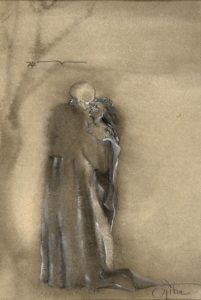
Life? or Theatre?
by Charlotte Salomon
Overlook Duckworth, 815 pp., $150.00
Charlotte Salomon: Life? or Theatre?: A Selection of 450 Gouaches
Taschen, 599 pp., $35.00
Excerpted from Painting on the Precipice, in the 22 February issue of NYRB
A woman walks down the red stairs of a tall roofless building. Her dress is almost black. Her hair is pulled back, her arms crossed against the cold, her face melancholy. She walks past denuded trees up a darkened street, curves into another, and another. The wind seems to be propelling her, tugging at her, so that at one point her hair tumbles free, her dress whirls. Lamplight turns pavement and road a stormy sea blue. As she comes closer her path is outlined in blood red, until red takes her over to transform her into a drowning figure in a blackened lake. [Read more…]
Geometry Born Of Dance: Nathan Hayden’s Strong Magic
at CB1 Gallery, Los Angeles (Through April 7, 2018)
Reviewed by Emily Nimptsch
What mystical visions and artistic insights can dancing an hour per day provide? For Nathan Hayden, a West Virginia-born, Santa Barbara-based psychedelic multimedia artist, this transcendental practice inspires the mind-bending imagery behind his abstracted landscapes, biomorphic ceramic sculptures, and hallucinatory wall murals. [Read more…]
Cinema as Transcendence: Annihilation And A Cinema Of Environment And Tone
Contemporary cinema is dominated by fast cutting and bombastic visual spectacle. Attuned to the fast times of the present, mainstream filmmaking runs at the pace of its audiences. It is a curious phenomenon considering the average blockbuster is actually quite long. Your typical Marvel film will run to about 2 hours and 15 mins. The recent, magnificent Black Panther features a sharp screenplay and visually rich vistas, yet it is engaging as a work of visceral energy. It rushes headlong through its vision and achieves the feat of making two hours feel like fifteen minutes. Alex Garland’s Annihilation arrives with a different approach, preferring to transcend its genre with a tone that is meditative and focused on creating an environment. [Read more…]
Louise Bourgeois: The Red Sky
at Hauser & Wirth, Los Angeles (Through May 20, 2018)
Reviewed by Emily Nimptsch
“My childhood has never lost its magic, it has never lost its mystery, and it has never lost its drama.” ㅡLouise Bourgeois, 1998
Produced in the last three years of her life, the effervescent bubble and flower doodles, rudimentary abstract patterns, and scrawled, Cy Twombly-like swirls currently lining the walls of Hauser & Wirth, Los Angeles, in Louise Bourgeois: Red Sky may seem like this renowned French-American painter, sculptor, and printmaker’s innocent, joy-filled ruminations on childhood, however, a closer look reveals a world of anguish and anxiety. [Read more…]
Judith Bernstein’s Money Shot
at Paul Kasmin Gallery, NYC
Reviewed by Phoebe Hoban
Judith Bernstein’s work has always been brazenly in-your-face. In the early-to-mid 1970s the self-styled “proto-feminist” was best-known for her huge charcoal drawings of hairy, phallic screws, one of which was censored from a museum show in Philadelphia in 1974, despite a petition signed by Louise Bourgeois and John Coplans. A co-founder of the alternative gallery, A.I.R., which showed only female artists, she more or less disappeared from the art world until 2012, when the New Museum featured “Hard,” a show of her large-scale work, including a 66-foot long mural painted directly onto its lobby windows, followed by two shows at Mary Boone in 2015 and 2016. [Read more…]
Dire States: The Liability Of Current Exceptionalisms
More than half of the United States’ population thinks “God” has a special relationship with America. This belief in the nation’s exceptionalism provides a basis on which a majority of people can imagine that the United States is exempt from the consequences of its actions. Rules of nature, decorum, civil behavior, and good citizenship in the global community simply don’t apply. This brand of exceptionalism builds on the related concept of individual exceptionalism in which people imagine themselves independent of responsibilities or accountability to such annoyances as speed limits and safety laws, rules and regulations, or regimens of diet and exercise. The fantasy of unlimited personal wealth which currently dominates the national imaginary is the ultimate extension of individual exceptionalism—one is simply a law unto oneself in a system where money legitimates views and actions. And, finally, completing the list, we have human exceptionalism–the hubristic belief that our species is superior to all others, simply by accident of our having achieved a high-level capacity for technological transformation and exploitation of natural resources. Even as we (probably fatally) dis-balance the living systems of the earth, the sense that “we” occupy a place of superior intelligence prevails. Each of these forms of exceptionalism has major liabilities and consequences for the ways the political system in America works and the terms on which self-justification proceeds. Meanwhile, damage continues at a great pace. [Read more…]
Annihilation Is Surely Ambitious Yet Sadly Underwhelming
Annihilation, directed by Alex Garland
Reviewed by Kristy Puchko
Alex Garland carved out a reputation as a stellar screenwriter with cerebral sci-fi fare like the zombie thriller 28 Days Later, the space-set adventure Sunshine, and the clone-centered romance Never Let Me Go. Then he shocked and awed critics and audiences alike with his directorial debut, Ex Machina. The high-tech fairy tale showed a crisp visual style that played beautifully with Garland’s heady, philosophizing script, and was roundly proclaimed one of the best films of 2014. So it was with great anticipation that critics awaited his follow-up, Annihilation. And while many have breathlessly sung the praises of Garland’s loose adaptation of Jeff VanderMeer’s novel, this critic was left cold. [Read more…]
Geta Brătescu: The Leaps of Aesop
at Hauser & Wirth, Los Angeles (through 20 May 2018)
Reviewed by Lorraine Heitzman
Of the three artists currently showing at Hauser & Wirth it is fair to assume that Geta Brătescu, the 92 year-old Romanian Conceptualist, is the least familiar to American audiences. Though her work has neither the heady bombast of Mark Bradford’s paintings nor the sinewy lyricism of Louise Bourgeois’ work, Brătescu brings her curiosity and playfulness to an encyclopedic body of work that spans seven decades. Her drawings, films, performances, animations, collages, and sculptures defy a single descriptor as they are based on her wide-ranging visual and literary interests and vary according to the medium but what Brătescu seeks to address in all of her work is the idea of transformation and multiplicity, especially in relationship to the role of the artist. While the exhibit will undoubtedly invite comparisons to Louise Bourgeois’ work because they were both active at the same time and because each gained recognition in a male dominated field, they have very different sensibilities. Where Bourgeois is so poetically expressive about her interior life through paintings, text and sculptures, Brătescu chooses conceptual and experimental genres to create imaginative narratives, her literary references and studio almost always present. Hauser & Wirth provides an opportunity to contrast both artists while introducing a new voice, albeit one that has flourished outside of our orbit for some time. [Read more…]
The Glorious Pageant Of Marvel’s Black Panther
The excitement that Marvel’s Black Panther has touched off in masses of Black people is undeniable.
It was a cultural phenomenon before it was even released, sparking conversation around Black representation in blockbuster films — particularly the lucrative comic book movie – and the importance of having Black creatives behind the camera as well as in front of it. With a Black director, writer, costumier, hairstylist, etc. and a budget of $200 million (higher than Thor: Ragnarok, for comparison), in many ways, this movie was a first of its kind. The budget and production value of this film has never been seen before, and it appeared that Marvel, now owned by Disney, was clearly addressing criticisms of diversity by throwing their full weight behind the project. Main cast members Chadwick Boseman, Michael B. Jordan, Angela Bassett, Lupita Nyong’o, Danai Gurira, and newcomer Letitia Wright led a marketing campaign that placed them front and center on magazines and billboards — occasionally dressed as actual Black Panthers and even as Jesus (side note: who else remembers when Kanye West covered Rolling Stone in a crown of thorns and the world lost its shit?). [Read more…]
Modernizing Modern Abstract: Mark Bradford’s New Works
at Hauser & Wirth, Los Angeles (Through May 20, 2018)
Reviewed by Emily Nimptsch
How do you modernize modern abstract painting? If you are beloved Los Angeles-based painter and collage artist Mark Bradford, you build thick, impasto-inspired canvas surfaces with ten to fifteen layers of paper in the form of attention-grabbing advertisements, photographs, newsprint, magazines, posters, and comic book panels. Shellacked with glue and lacquer, you dry them in the sun, bleach them, and sand them down, partially exposing the forgotten strata below. With Bradford’s wildly inventive, semi-geological paintings, the viewer acts as an archaeologist from some distant future excavating the remains of our modern society. Also acting as socio-political city maps and diagrams of the human body, this MacArthur Fellow’s masterful large-scale fusions of Abstract Expressionism, Pop art, and Street art allow the audience to consider issues of LGBTQ rights, the AIDS epidemic, and systemic racism through the lens of both the micro and the macro. [Read more…]
Jasper Johns: Something Resembling Truth
at the Broad, Los Angeles (through March 13, 2018)
Reviewed by Emily Nimptsch
My work is largely concerned with relations between seeing and knowing, seeing and saying, seeing and believing. Preconceptions which are sort of “knowing” may be placed in doubt or may be affirmed by seeing. 一 Jasper Johns, 1965
In a sudden moment of creative clarity and focus, Jasper Johns awoke from a dream in 1954 with a vision of the American flag dancing around in his head. The then-emerging New York-based multimedia artist knew immediately that he had to paint it. Not having the money for a new canvas, he simply used some old bedsheets instead. Little did Johns know at the time that he was creating an image that would elevate him to the upper echelons of artistic fame and forever alter the course of art history.
Now sixty-four years later, the Broad Museum, the mecca for all things modern art in Los Angeles, is looking back on this celebrated artist’s momentous collection of flag paintings in concert with his later number, target, and map works. Consisting of over 120 paintings, drawings, sculptures, and prints, including many that have never displayed in the city before, this extensive and historically significant collaboration between the Broad and London’s Royal Academy explores Johns’s oeuvre thematically rather than chronologically. This curatorial choice allows the viewer to see works of different eras on the same wall and make unexpected, eye-opening connections. [Read more…]
Sally Potter’s The Party Gives a Bang, Then Fizzles
English writer/director Sally Potter has built her reputation on challenging dramas, like the gender-bending Orlando, the revolution-focused Ginger & Rosa, and Yes, a steamy romance with poetic dialogue set to iambic pentameter. Maybe that’s why The Party is so jarring. Though sharply cast and leanly executed, this dark comedy about a band of elitist London liberals feels strangely safe, and ultimately underwhelming. [Read more…]
Rico Lebrun In Mexico
at Jack Rutberg Fine Arts, Los Angeles (through March 17, 2018)
Reviewed by Lorraine Heitzman
Discovering Rico Lebrun in Mexico at Jack Rutberg Fine Arts is a thrilling experience in the way that the best introductions are: eye-opening and ultimately rewarding. At the same time it is a little confounding too because the work is unfamiliar and it shouldn’t be. These are large paintings of tremendous, muscular force that are as passionate as they are perfectly constructed. That the work was made over sixty years ago and largely overlooked is bewildering. To paraphrase Jack Rutberg, “Only in L.A.” [Read more…]
Glenn Harcourt’s The Artist, The Censor, And The Nude
Excerpt published with permission of DoppelHouse Press, Los Angeles.
The Artist, The Censor, and The Nude: A Tale of Morality and Appropriation
By Glenn Harcourt
DoppelHouse Press. 190 pp. $34.95
by Glenn Harcourt

Of all the topographies that exist in the world, that of the human body is perhaps the one that has been the most relentlessly contested – both the actual body comprising flesh and blood, and the virtual body as it is written and visualized in representation. This is true of the body both male and female, and of the body both clothed and unclothed. Issues of personal and cultural identity; of sexual and theological politics; of religious and political ideology are all articulated in terms of the body and its represented image. The body as it is lived and pictured serves both to instantiate and to adjudicate cultural norms and to facilitate their transgression.
Thus it is that both the body and its image have come to be censored, at various places and times, and under many cultural regimes. That censorship has certainly been a fact in post-Revolutionary Iran, where laws governing the dressing, adornment, and deportment of the physical body, as well as the body’s image in cultural production have been continuously in place, if at times somewhat erratically enforced. [Read more…]
Night Falls On Caroline Walker’s Sunset
at Anat Ebgi, Los Angeles (Through March 10, 2018)
Reviewed by Emily Nimptsch
With its twinkling city lights in the distance, seductive glow of the illuminated swimming pool below, and sumptuous sheen of the satin nightgown worn by the seated woman in the foreground, the painting Tinseltown (2017) and all of the other works on display in Sunset — the debut exhibition from London-based figurative painter Caroline Walker’s at Anat Ebgi — delight the eye and highlight the lavish lifestyle of a chic, mature woman living in the Hollywood Hills. Through the twelve oil paintings and works on paper displayed here, she is depicted lounging in the pool, trying on clothes and brunching at the famed Beverly Hills Hotel. Although this David Hockney-esque realm of fantastical wealth and luxury is enviable, one cannot help but feel a twinge of sadness hanging in the air. Perhaps this melancholy stems from the fact that she is all alone. Ultimately, Sunset takes the viewer on a tour of the most glamourous haunts of Hollywood’s rich and famous while simultaneously revealing this woman’s most private thoughts and desires. [Read more…]
Art et Liberté: Rupture, War and Surrealism in Egypt (1938–1948)
at the Tate Liverpool (through March 18, 2018)
Reviewed by Charles Shafaieh
Excerpted from Art et Liberté: Egypt’s Surrealists in the 3 February NYRB

In March 1938, the Egyptian poet and critic Georges Henein and a small group of friends disrupted a lecture in Cairo given by the Alexandria-born Italian Futurist F.T. Marinetti, who was an outspoken supporter of Mussolini. Six months later, Henein, along with the Egyptian writer Anwar Kamel, the Italian anarchist painter Angelo de Riz, and thirty-four other artists, writers, journalists, and lawyers, signed the manifesto “Vive l’Art Dégénéré!” (“Long Live Degenerate Art!”) that would inaugurate Art et Liberté, a short-lived but influential artists’ collective based in Egypt that is the focus of an illuminating exhibition currently at the Tate Liverpool, in Britain, covering the years 1938–1948. Printed in Arabic and French, with a facsimile of Guernica on its reverse, the declaration was a direct challenge to the previous year’s Nazi-organized exhibition “Entartete ‘Kunst’” (“Degenerate ‘Art’”), which presented art by Chagall, Kandinsky and other modern artists, largely Jewish, that the Nazi Party deemed decadent, morally reprehensible or otherwise harmful to the German people. [Read more…]
Catherine Opie: The Modernist
at Regen Projects Los Angeles (Through February 17, 2018)
Reviewed by Emily Nimptsch
Bursting onto the Los Angeles art scene in the early 1990s with her enthralling and empathetic portraits of the LGBTQIA community, internationally acclaimed Ohio-born photographer Catherine Opie is currently setting the city ablaze again with the release of The Modernist, her haunting and provocative debut film project at Hollywood’s Regen Projects.
In the middle of the gallery floor, guests will find a sleek and reflective box-like structure. Built by Los Angeles-based architect Michael Maltzan, a Los Angeles-based architect known for his work on Pasadena’s Jet Propulsion Laboratory Building, the Sixth Street Viaduct, and Regen Projects itself, this highly futuristic form houses the film projector and some seating while complimenting the film’s space age aesthetic. Lining the walls of the gallery, visitors will also find 33 photographs highlighting significant moments in the film. [Read more…]
Decadent Mirrors: Babylon Berlin as Reflection of Past and Present
Is history born on the battlefield or in the subterranean corners of a city? This is the nature of the question of how the modern era came to be. We now live in that transitional period in the historical timeline, that moment between eras where nothing is defined but tensions saturate the air. The Italian revolutionary and intellectual Antonio Gramsci once described such a moment as, “The old world is dying, and the new world struggles to be born; now is the time of monsters.”
Babylon Berlin, a feverish noir imported from Germany by Netflix and now streaming on the service, takes place in one of the great seminal in-between moments in modern history. It is set in Berlin during the Weimar years, that brief interlude after World War I when Germany found itself being both a key center of cultural innovation and social powder keg. [Read more…]
Ecofeminism and The Elevation of Female Voices
The Feminine Sublime
At Pasadena Museum of California Art (Through June 3, 2018)
Reviewed by Emily Nimptsch
Offering a feminist perspective on the divine, art historical tradition, as well as widespread issues currently plaguing our planet, including climate change, consumer waste, terrorism, and the downsides of technology, The Feminine Sublime, currently on view at the Pasadena Museum of California Art, highlights the socially and politically charged work of five prominent Los Angeles-based female painters Merion Estes, Yvette Gellis, Virginia Katz, Constance Mallinson, and Marie Thibeault. [Read more…]