Riot Material

Art. Word. Thought.

  • Home
  • Riot Material Magazine
    • About Riot Material
    • Entering The Mind
    • Contact
    • Masthead
    • Categories >
      • Art
      • Artist
      • Books
      • Cinema Disordinaire
      • Film
      • Interview
      • Jazz
      • Riot Sounds
      • Thought
      • More   >
        • Architecture
        • Image
        • Records
        • The Line
        • The New Word
        • That Evening Sun
        • The Natural World
        • Video
  • Art
    • Art Reviews
  • Books
    • Book Reviews
  • Film
    • Film Reviews
  • Records
    • Jazz Reviews
    • All Reviews
  • Riot Sounds
  • Cinema Disordinaire
    • Riot Cinema

An Interview With Guillermo Bert

November 6, 2017 By Christopher Michno

By Christopher Michno

Guillermo Bert’s Encoded Textiles Project, a series of exquisitely wrought tapestries that embed the stories of indigenous communities through QR codes woven into the textiles themselves, brings together traditional weaving techniques, digital technologies and stories of identity. The QR codes within the weavings launch additional content and documentary video Bert shot while working with weavers in Chile and Oaxaca, Mexico. His tapestries are currently on view in two Pacific Standard Time: LA/LA exhibitions in Los Angeles—The U.S.-Mexico: Place, Imagination, and Possibility at the Craft and Folk Art Museum, and Mundos Alternos: Art and Science Fiction in the Americas at the UCR Arts Block. They also may be seen in two museum exhibitions: Unsettled, at the Nevada Museum of Art in Reno, reframes human migration within the context of a vast super-region that encompasses the western edge of the Americas from Alaska to Patagonia and much of the Pacific; and Tied, Died, and Woven: Ikat Textiles from Latin America, at the Textile Museum of Canada, juxtaposes textiles from the museum’s permanent collection with contemporary objects by Bert and other artists.

QR code

In a conversation at the Nevada Museum of Art, Bert discussed his move from Chile to Los Angeles in 1981 and elaborated on his Encoded Textiles project and how it came about.

CHRISTOPHER MICHNO: You came to Los Angeles after you finished school in Chile. What drew you to LA?

BERT: We have family here, so we came straight to LA. The reason we left Chile, I was in college when Pinochet was in power. And it was still Pinochet for another 10 years after I left. So it was in the middle. I was very young when the coup happened. So the five years I was in College, there wasn’t real freedom of expression. You had a lot of repression, in fact. I finished in December, and we left in January. I developed my entire career in the United States. But I was educated and my formative years were in Chile. So I was very attuned to politics.

MICHNO: What kind of work were you doing before Encoded Textiles?

The Price of Democracy

BERT: I was working with street posters. Originally I did traditional painting, and then I did a lot of collage and photography. Right now, I’m doing a lot of video. Prior to Encoded Textiles, I did some pieces with vertical bar codes. They referred to the code as an object. The code itself was like the price of a product, for example, “The Price of Democracy.” They were highly glossed—luxuries, if you wish. But they were titled, “The Price of Democracy,” or “The Price of Justice.” Values became commodities. That series was called the Bar-Code Series. When the next generation code came about, I thought it would interesting to use it with the tapestries. I thought it could capture identity through the codes, for example, the tradition and the language embedded in the code, and to have it woven as a conceptual piece of art.

Bert next to Mapuche Portal #1

I see it as a more universal concept. The craftsmanship has thousands of years of history and is a portal that allows you to interact with these communities.

MICHNO: You’ve been working on the weavings for 6 – 7 years?

BERT: Exactly. It evolved quite a bit. These are two different examples. [Bert refers to the two weavings on display in the museum, Zapotec Poet (2015), and Mapuche Portal #1 (2014).] This is from Oaxac, this is from the Mapuche.

MICHNO: I saw some photos of women working on these weavings. Are these traditional, hand woven pieces?

BERT: Totally, yes. These are from different countries. Mapuche Portal #1 was made in Santiago. But some of the other pieces were done in the south of Chile. On one occasion, the weaver from the Mapuche community, Anita Pailami, flew to LA and worked with me for several months in Los Angeles. The Zapotec pieces were made by the Navarro sisters. They have the lovely situation where they have a house with a big patio, and the three of them sit on the ground, and they do what is called back-strap looming. They strap the loom around their back and then to a tree, and they can just do small pieces because it is limited by whatever you can reach with your hands. And then you sew it together and build a larger piece.

Anita Pailami

Each country and each community has different weaving techniques, and they have different stories to tell that reflect different traditions, mythologies, cosmologies.

So we traveled to different communities. We started videotaping, and interviewing, and recording that segment of the culture and the language, and those videos end up encoded in these [QR] codes.

MICHNO: In terms of encoding, you’re encoding multiple things here. You’re encoding a particular cultural history; there is also technology that is embodied in the way the weaving is made that is specific to particular communities; but then you’re also using these QR codes.

BERT: Right. These are definitely interactive pieces—I call them portals. [For Mapuche Portal #1] I asked Graciela Hurao—she is one of the biggest poets in Mapuche culture—if she could do research and reinterpret the traditional stories of the Mapuche people. We made some videos with her where she read the traditional stories for us. So we did ten stories, and we encoded one in the QR code.

Graciela Hurao

We developed software that enabled us to swap the codes, so you can scan it once and listen to one of the stories of the Mapuche people. But if you scan it in a month, it’s going to be a different story, and then another one and another one.

So there’s going to be ten stories bouncing from tapestry to tapestry. We’re planning on doing ten of these tapestries.

MICHNO: And what is the market for these traditional weavings, if a Mapuche weaver were to bring them directly to market?

BERT: They have a couple of outlets for that, and normally they show weavings in Santiago in various boutiques. They also export weavings to Europe. There are a number of organizations in Chile and through the United Nations that help native tribes to promote their work.

MICHNO: You said you didn’t know if the QR code in the weaving would actually work as a QR code?

BERT: The museum show to exhibit that work was scheduled two years before I made my first tapestry. For two years we worked without knowing whether it was possible to do it. So that’s why I had to fly the Chilean weavers to the States to work with me in the studio—the process was very difficult.
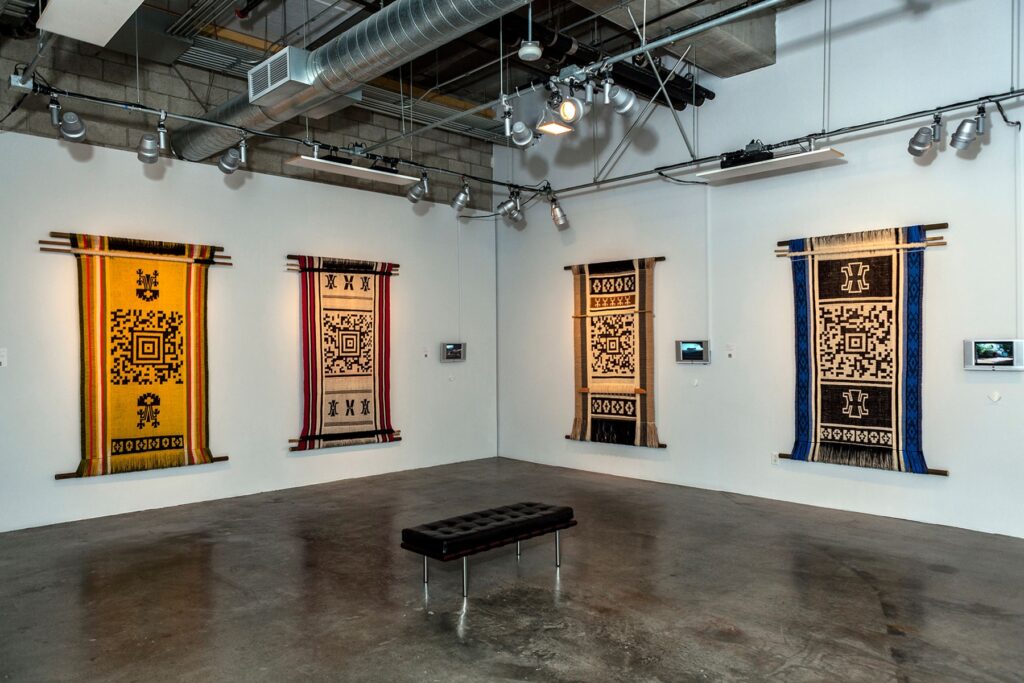
Guillermo Bert: Encoded Textiles, at the Pasadena Museum of California Art

In Chile they still use what is called the vertical loom, which is just a piece of wood on the top and bottom. They weave it with a very thick thread. The codes we used for that series—it was in the show at the Pasadena Museum of California Art [Guillermo Bert: Encoded Textiles, October 28, 2012-February 24, 2013]. All of those pieces are Mapuche textiles. They are all 8 feet tall by 5 feet wide. The code has to be large enough because of the thick thread in order to be read—you have to have it a certain size. In fact, when we first did this, the first code was much more dense than [what you see now], and it was impossible. It had eight hundred squares to be precise enough with that thick thread. After a year, when we managed to make it read, we had a big celebration. And then we did the other ones. We simplified the codes, so it was a process.

La Bestia

So in the beginning it was actually very difficult to pull it together and make it work, but after we did that, we moved on to other countries. Zapotec was much easier because the code could be smaller and more precise. [The Zapotecs in Oaxaca use a pedal loom, which allows for smaller thread.]

The pieces that are at CAFAM are a mix of the tapestries made with the back-strap loom used by the Mayans and some photo transfers that I created with a laser, so it’s 3-D on canvas.

But that particular piece is interesting because the train that’s depicted in the piece is called La Bestia—the Beast—it’s a freight train that brings people from the Central America to the United States. People just jump onto the back of the train.

The picture of that train is faded out in the back, and the colors are in front. As you scan the code, the story that is behind the code is of somebody who is of Mayan origin that lives in Los Angeles and is describing the voyage. He actually came on that train. And he’s talking about life in Guatamala, as a Mayan, and the journey to the train, and what it’s like for him to live in Los Angeles.

There’s a direct connection between the image and the actual code, but all these other traditional stories are stories of their own land. But this one is called the Exodus Series. It’s tells the stories of people that live in Los Angeles but have come from those communities. So it adds a new twist to the story.

The loom

MICHNO: I don’t know if you intended for this to be part of the conversation, but also embedded is how we value work, and how we value traditional forms of work versus other forms of work. Is it just a by-product of how it came about, or was it something you considered in advance?

BERT: No, I never thought of it in advance. I thought about the conceptual element and whether it works or not, and whether it interests me or not. This has an anthropological edge to it. I had never really worked with an indigenous culture before, so this is a new thing for me. I’d never made a documentary film before. So it was a completely different approach to my art making, but it was so rewarding. Traveling around different countries, filming stories, and the stories were amazing. So I got totally in love with the process and with the material.

MICHNO: When you first started thinking about the project, how did you think about the the work of indigenous communities related to traditional art forms?

BERT: I was thinking, and this is particularly true for me, being Latin American in the United States, the idea of identity is always present. When I traveled to different countries in Latin America and see these indigenous populations, you can see clearly that they are losing their identities. They are losing their languages, their traditions, their religions. And I thought, you know, I live in America, but the people, their identity has been stolen.

Coded Stories: The Mapuche

So I thought that there was a parallel between these two elements. In one instance, they don’t belong to the mainstream, they don’t use the language as much, they are losing who they are. And then in America, your identity can be digitized and then it can be stolen. So I thought this code is a transition in between, it is a portal. I thought, ‘These codes already look like traditional tapestries, what if we infuse them with this culture and this tradition and language, and you can tell a story?’ And at the same time, you can use the traditional two-thousand year old weaving techniques to produce it.

And, I thought, the way that they communicate is through an oral tradition, so this is going to be like an oral tradition in the twenty-first century, where you use your cell phone to access through these codes, but they are still weaving the entire piece, as you access it, and it becomes an interactive piece. So the marrying of these two technologies, I thought it would be exciting to see. It’s a form of archiving the culture, of course, and making it more accessible and reinserting it into the mainstream, if you wish. And that allows them to save a piece of their identity in the same way that you’re losing your identity when it has been digitized and replicated or copied. So I thought it was something in between that is represented by this process.

~

Christopher Michno is a Los Angeles area art writer and the Associate Editor of Artillery. His work has also appeared in KCET’s Artbound, the LA Weekly, ICON, and numerous other publications. He is also an editor for DoppelHouse Press, an LA based publisher that specializes in art, architecture and the stories of émigrés.

Filed Under: Artist, Interview, The Line

The Line

A poetic interpretation of Anselm Kiefer's Exodus, at Los Angeles Marciano Art Foundation, is at Riot Material.

On Wing With Word Through Anselm Kiefer’s Exodus

Gagosian at Marciano Art Foundation, Los Angeles (through 25 March 2023) by Rachel Reid Wilkie Los Angeles poet Rachel Reid Wilkie was given the task of walking into Anselm Kiefer’s Exodus — a literally monumental exhibition, in that each of these paintings are upwards of 30’ tall — and addressing the colossal artworks “cold,” as in […]

Detail of Henry Taylor, "Warning shots not required," 2011. At Riot Material magazine.

Henry Taylor’s B Side: Where Mind Shapes Itself to Canvas

Henry Taylor: B Side at MOCA Grand, Los Angeles (through 30 April 2023) Reviewed by Eve Wood Ages ago when there were LP records and 45s, the B side of a popular single made allowances for experimentation and could be counted on as an alternative vision to the more mainstream and compulsory hit single. B […]

Songbook of a Bygone Dead: Bob Dylan’s The Philosophy of Modern Song

Reviewed by Dan Chiasson The Philosophy of Modern Song by Bob Dylan Simon & Schuster, 352pp., $28.93 NYR Bob Dylan’s new book, The Philosophy of Modern Song, is a kind of music-appreciation course open to auditors and members of the general public. It is best savored one chapter, one song, at a time, while listening to the […]

Smoking the Bible by Chris Abani

Words To Wrap Around A Dying Brother

Smoking the Bible Reviewed by Rhony Bhopla Smoking the Bible by Chris Abani Copper Canyon Press, 96pp., $15.99 HR Chris Abani’s autobiographical book of poems, Smoking the Bible, centers on the relationship of two brothers growing up in Nigeria with an Igbo father and an English mother. The poems, which incorporate the Igbo language along […]

Grant Wallace, “Through Evolution Comes Revelation.” at Riot Material magazine.

Communication Breakdown: Grant Wallace, His Heirs & the Legacy of a Forgotten Genius

Grant Wallace: Over the Psychic Radio at Ricco/Maresca Gallery, NYC (through 3 December 2022) By Michael Bonesteel Freelance writer and editor Deborah Coffin of Albany, California, was in graduate school at the University of California, Berkeley in 1997 when she first encountered street musician Brian Wallace at a party. “I had a friend who knew Brian,” […]

The Joshua Tree Talk

A Conversation on Dzogchen C von Hassett & Rachel Reid Wilkie at Joshua Tree Retreat Center 

Louise Bourgeois: What Is The Shape of This Problem?

at University of Southern California, Fisher Museum of Art. (through 3 December 3, 2022) Reviewed by Margaret Lazzari Louise Bourgeois is widely recognized for her sculptures and installations, but Louise Bourgeois: What is The Shape of This Problem is a wonderful opportunity to immerse yourself in her perhaps-lesser-known prints, fabric work and writings. This exhibit contains over […]

Moonage Daydream Conveys More Myth Than Man

Moonage Daydream Dir. Brett Morgan Reviewed by Nicholas Goldwin As one of the greatest shapeshifters in the expansive history of rock music, it seems only fitting that the documentary with David Bowie as its subject never seems content to express the trials, tribulations and artistic triumphs of Bowie in any one fixed way. This is […]

Carnación di Rocío Molina, at Riot Material Magazine.

On Binding: Notes from Venice

Bienalle Arte and Bienalle Danza, Venice 2022 By Allyn Aglaïa Chest bound, lips sealed, I walked through Venice alone, quiet, and: thought about narratives that bind us to erotic binds

Mohammad Barrangi's Guardians of Eden (Dreamscape #8), at Riot Material magazine.

Transcendence Beyond Erasure in Mohammad Barrangi’s Dreamscape

at Advocartsy, Los Angeles (thru 5 November 2022) Reviewed by Christopher Ian Lutz Fantasy requires a symbolic vehicle to transport a character from the real world into the imaginary realm, where the laws of reality are subverted or obscured to justify an otherwise absurd event. The artist might depict the vehicle as a real object […]

Soul Crash: Our Slow, Inexorable Release Into the Metaverse

by Sue Halpern The Metaverse: And How It Will Revolutionize Everything by Matthew Ball Liveright 352pp., $18.89 NYR In October 2021, when Mark Zuckerberg announced that Facebook would now be called Meta and its business interests would be pivoting to the metaverse, there was almost universal confusion: most observers had no idea what he was […]

green tara

Pointing the Staff at the Old Man

A wisdom transmission by Samaneri Jayasāra Excerpted from —  Advice from the Lotus Born  from the chapter “Pointing the Staff at the Old Man” Translated by Eric Pema Kunsang Rangjung Yeshe Publications, 184pp., $21.95 . .

Margaret Lazzari’s "Shimmer." From the exhibition "Breathing Space."

Margaret Lazzari’s Luminous Breathing Space

at George Billis Gallery, Los Angeles (through 8 October 2022) Reviewed by Nancy Kay Turner “Things are not what they seem: nor are they otherwise.” –Buddha Margaret Lazzari’s luminous solo exhibition of paintings, entitled Breathing Space, were painted during the pandemic, and the exhibition title is indeed significant. It’s defined as a respite, a hiatus, or an […]

From Phil Tippet's Mad God, reviewed at Riot Material magazine.

Nihilism Births Its Own Interminable Hell

Mad God Dir. Phil Tippett Reviewed by Nicholas Goldwin Technically astonishing and immersive to a fault, director Phil Tippett successfully demonstrates that thirty years of relentless dedication to your craft can lead to cinematic innovations even his old stomping grounds – the sets of Star Wars and Jurassic Park – have yet to catch up. […]

A Look Back on an Iconoclast: Art Critic Dave Hickey

by Jarrett Earnest Far From Respectable: Dave Hickey and His Art by Daniel Oppenheimer University of Texas Press, 141 pp., $24.95 The Invisible Dragon: Essays on Beauty, Revised and Expanded by Dave Hickey University of Chicago Press, 123 pp., $15.00 (paper) Air Guitar: Essays on Art and Democracy by Dave Hickey Art Issues Press, 215 […]

John Lurie’s The History of Bones

Reviewed by Cintra Wilson The History of Bones: A Memoir by John Lurie Random House, 435 pp., $28.00 NYRB It was 1989 when I saw John Lurie on TV in a late-night advertisement for the new Lounge Lizards album, Voice of Chunk, which was “not available in stores” and selling exclusively through an 800 number. Operators were standing […]

Marlene Dumas, "Losing (Her Meaning)," 1988. At Riot Material magazine.

Marlene Dumas’ Masks of Inborn Gods

open-end, at Palazzo Grassi, Venice (through 8 January 2023) Reviewed by Arabella Hutter von Arx Four relatively small artworks greet the visitor in the first room of the Marlene Dumas exhibit, open-end, at Palazzo Grassi. D-rection shows a young man contemplating his rather large and purple erection. A bluish white face and a brown face unite […]

Clarice Lispector

Baffling the Sphinx: The Enigmatic World of Clarice Lispector

Reviewed by John Biscello Água Viva by Clarice Lispector New Directions Publishing 88pp., $14.95 Too Much of Life: The Complete Crônicas by Clarice Lispector New Directions Publishing 864pp., $29.95 The word is my fourth dimension –Clarice Lispector And on the eighth and endless day, where the bottomless hallelujah meets Ouroboros, God created Clarice Lispector. Maybe. […]

Donna Ferrato "Diamond, Minneapolis, MN 1987." At Riot Material magazine

Donna Ferrato’s Magnificent Holy

at Daniel Cooney Fine Art, NYC (through July 29 2022) Reviewed by Phoebe Hoban The small scale of Donna Ferrato’s snapshot-like black-and-white photographs belies their personal and political power. Whether they document the medical sinks and shelves in a now-shuttered Texas abortion clinic, or hone in on the badly bruised face of a domestic violence […]

Darcilio Lima Unknown Lithograph, 1972. At Riot Material magazine.

Magia Protetora: The Art of Luciana Lupe Vasconcelos and Darcilio Lima

at the Buckland Museum of Witchcraft and Magick, Cleveland OH (through 30 September 2022) Curated by Stephen Romano Gallery Reviewed by Christopher Ian Lutz The extension of a lineage occurs not merely by the repetition of form, but by the intersection of conservation and revolution. Transformation is fundamental to preserving the essence of a given tradition’s rituals and […]

Eve Wood's A Cadence for Redemption, written in the fictive voice of Abraham Lincoln, is excerpted at Riot Material magazine.

Songs For Our Higher Selves

A Cadence for Redemption: Conversations With Abraham Lincoln by Eve Wood Del Sol Press, 46pp., $5.99 Employing the fictive voice of a former president, Eve Wood shifts the perspective on the happenings of our times – where all indicators point to the slow, inexorable collapse of the American Experiment – to the one man who […]

The Clear, Crisp Taste of Cronenberg

Crimes of the Future Reviewed by Anna Shechtman and D.A. Miller Neon NYRB A line from Crimes of the Future, David Cronenberg’s latest film, has been trailing it around with the campy insistence of an old-fashioned ad campaign: “Surgery is the new sex.” On receiving this information, a skeptical Saul Tenser, played by Viggo Mortensen, asks, “Does there have […]

Georganne Deen, How to prepare people for your weirdness (Painting for a gifted child) 2022

Conjuring a Divine Silence in Georganne Deen’s The Lyric Escape

at Rory Devine Fine Art, Los Angeles (through 6 August) Reviewed by Eve Wood Albert Camus once famously asked, “Should I kill myself, or have a cup of coffee?” One can only hope that this was a rhetorical question, yet however ironic, it is still a sentiment worth pondering, especially considering today’s current socio-political climate […]

Pesticides in our foods inevitably enter the body and will have the intended effect of killing the organism. Which is to say you are certain to become diseased and evenutally die from the longterm ingestion of industrial pesticides.

A Strictly Organic Diet is Good Enough to Save Your Life

A chapter excerpt from Entering the Mind, the new book from C von Hassett which speaks to an ageless way of resting the mind in meditation to both recognize and stabilize in its already Awakened state. Yet to do this successfully, we must first cleanse the body of its myriad mind-fogging toxins taken in through […]

Milton’s Quotidian Paradise, Lost

By Catherine Nicholson Katie Kadue: Domestic Georgic: Labors of Preservation from Rabelais to Milton Timothy M. Harrison: Coming To: Consciousness and Natality in Early Modern England Nicholas McDowell: Poet of Revolution: The Making of John Milton Joe Moshenska: Making Darkness Light: A Life of John Milton NYRB Of the many liberties John Milton took in writing Paradise Lost, his 1667 epic […]

Foucault in Warsaw and the Shapeless, Shaping Gaze of the Surveillance State

Reviewed by Marcel Radosław Garboś Foucault in Warsaw by Remigiusz Ryziński  translated by Sean Gasper Bye Open Letter Books, 220pp., $15.95 Harvard Review Since Poland’s state socialist system collapsed in 1989, the records of its police agencies and security services have gone to a government commission entrusted with the “prosecution of crimes against the Polish […]

Noah Davis, Untitled (2015)

The Haunt of One Yet Faintly Present: Noah Davis, Still at Home

Noah Davis, at the Underground Museum, Los Angeles Reviewed by Ricky Amadour Directly across from the entrance, an opening statement to Noah Davis, at the Underground Museum, reads “many of the paintings you are about to see were painted in this space.” Smudges, dribbles, and droplets on the floor embody the physical notion of Davis […]

Julian Schnabel, The Chimes of Freedom Flashing (detail), 2022

The Supremely Humanistic Hand of Julian Schnabel

For Esmé – With Love and Squalor, at Pace Gallery, Los Angeles (through 21 May 2022) Reviewed by Eve Wood How does one represent, let alone quantify hope, hate, grief, love, joy, tragedy, or anything, for that matter, which stands in opposition to something else? Throughout his illustrious career, Julian Schnabel has always been one to […]

Rose Wylie, "I Like To Be" (2020)

In Full Surrender to the Wylie Eye

Rose Wylie: Which One, at David Zwirner, NYC (through 12 June) Reviewed by David Salle Rose Wylie: Which One by Rose Wylie; with Barry Schwabsky, Judith Bernstein, and Hans Ulrich Obrist David Zwirner Books, 196pp., $75.00 NYRB Rose Wylie, who is now eighty-seven, has been painting in the same rural studio in Kent, England, since […]

The Artful Construction of The ‘I’

by Merve Emre NYR The essay form…bears some responsibility for the fact that bad essays tell stories about people instead of elucidating the matter at hand. —Theodor Adorno The personal essay is a genre that is difficult to define but easy to denounce. The offending element is rarely the essay as a form, but its […]

Copyright © 2025 · News Pro Theme On Genesis Framework · WordPress · Log in