
Bruno Mars is an agent of the system of white supremacy. There. I said it.
More pointedly, Mars is representative of a system that smudges out Black people, specifically Black Americans, while white and non-Black persons of color benefit from anti-Black racism and white supremacy. If Mars were white, we—the Black community—would not be okay with it. Yet despite the fact that he is not white, that still does not make him Black, and it in no way indicates that he is not benefitting from anti-Black racism as a non-Black person of color. Rather, the stark and barefaced opposite is true.
Per his handlers, Mars was remolded from doing ukulele pop music like “The Lazy Song” and saccharine hits like “Grenade,” to wearing backwards caps and dookie chains talking about “dripping in finesse.” He has moved from one traditional Black American genre to another traditional Black American genre like some kind of amorphic parasite, changing his image in wholesale fashion as he scuttles along – from zoot suits and suspenders and permed conks when he was in his du-wop/Frankie Lymon phase, to dressing up like Morris Day and the Time impersonating Prince in his funk phase, to wearing Kross Kolor fits and a fake afro in his 80s/90s phase. Bruno is a blackface karaoke singer. He uses stereotypical Black racial signifiers to imply Black coolness and ride off a wave of Black American nostalgia. There is nothing original in Bruno Mars, save perhaps that ukulele. He is all marketing stratagems; a physical embodiment of numbers and projections. Little of the man has any notable mettle.
His racial ambiguity allows for mercurial slipping into the present vacuums of critical listening, assessment, and thought. To that end he is the master dissembler: he is, he tells us, a quarter Puerto Rican and grew up with a Filipino mother in Hawaii doing Elvis impersonations. Which is to say he did not grow up immersed in Black and Latinx culture. Instead, he throws out as a mark of credibility such character defining phrases as, “My father was a Puerto Rican pimp,” — a defense of both vocation and self that rings all-too familiar and not at all dissimilar to white folks who mention having a Black friend or voting for Obama. It’s faking the funk, plain and simple. Someone clearly caught on to the fact that it was a genius marketing strategy to continue to have him extrapolate from and impersonate Black artists, and his career trajectory took off like a rocket once he decided to vulture his way through the last 75 years of Black American music.


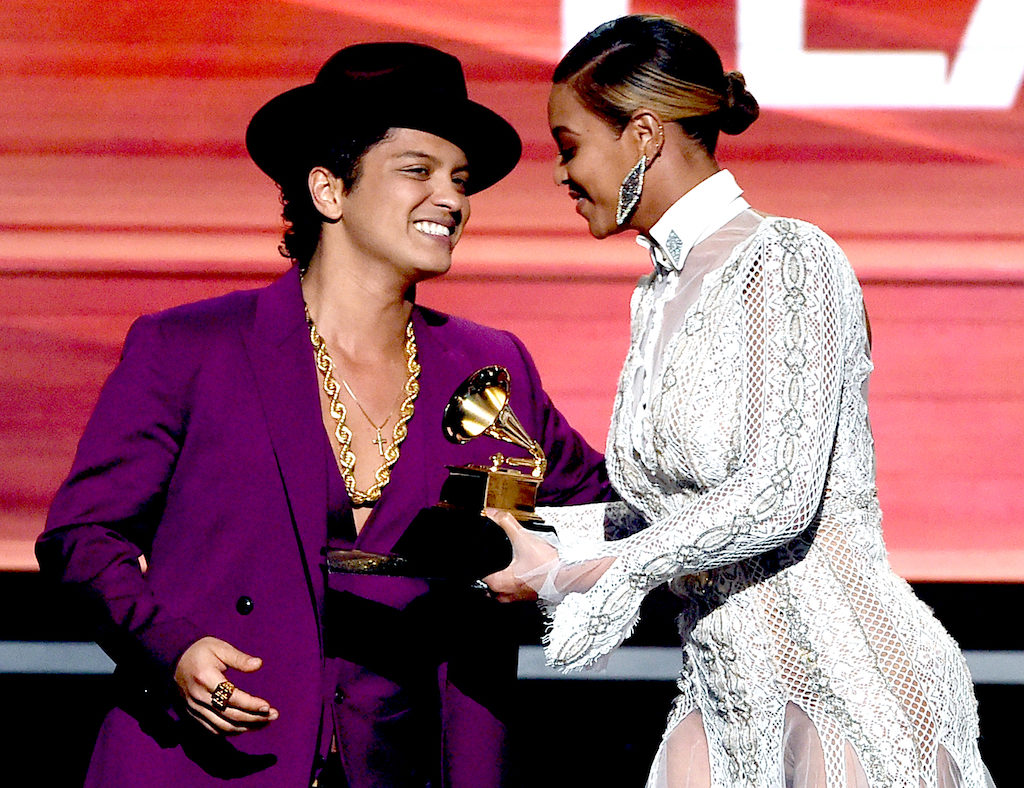


The many constructions of Bruno Mars
Even lighter skinned/mixed Black artists, while benefiting from colorism, do in fact still have to contend with being Black and dealing with anti-Black racism. FKA Twigs is a prime example of this. She has spoken out about how her music was labeled “alternative” prior to anyone seeing her; once she began releasing music videos, however, she promptly became R&B. A racist system will never award a Black artist – even a lighter skinned or mixed one – the way they will reward a non-Black artist like Bruno Mars. And while award shows like the Grammy’s have long shown that they are out of touch, racist, and completely subjective in terms of dispensing value, the larger issue of them being symptomatic of a system that loves Black culture while despising, fearing and actively oppressing Black bodies cannot be ignored. This is the system that gunned down 12-year-old Tamir Rice within two seconds of police arriving at the park where he sat with a toy, yet will cheer at a white cop doing the ‘whip’ and the ‘nae nae.’
Black artists are put in a box the way a Bruno Mars will never be, and at any moment Bruno can also snatch that curly perm out his hair, take off the gold chains and go back to doing the bland pop and no one will bat an eyelash. Actual Negroes are Negroes until the end, no matter what, so that box rarely cracks wider than the given persona or role – again, look at the reaction when Beyoncé dared to dabble in country music, a genre that was as much created out of the Blues as it was Appalachian folk.
Mars’s racial ambiguity also allows for songs with the exact same questionable lyrics as those by Black artists to be played in diners and hipster cafes, Wal-Mart’s and Home Depots, because the truth is he’s not an actual threatening Black body. He then wholly benefits from a racist system and is no less similarly complicit in that same system. And it isn’t an isolated event: non-Black persons of color, from artists to activists, often reap Black culture – especially the artistic and academic – for their own ideas and inspiration, while wholly benefiting from and even perpetuating anti-Black racism.
Many have asked: where is the line of cultural appreciation versus appropriation? That line is crossed with the power and privilege that allows you to benefit and profit off a subjugated culture. Our Black American culture is subjugated to the point where a non-Black person can take whatever they want from us and get elevated for it. They can make millions of dollars, get awards and accolades handed to them, wherein a Black artist doing similar music is not seen as being original or remarkable and is more often than not ignored. I can appreciate Native American culture without dressing up in a headdress, and I can be inspired by and pay homage to it without playing a peace pipe. Bruno can love, appreciate, and pay homage to Black American culture without doing a literal impersonation of artists and genres, and to be honest, with his amount of talent, the fact that Bruno Mars doesn’t do anything original is nothing short of lazy. Lin Manuel Miranda’s Hamilton is a prime example of appreciating various genres to make something fresh and new, with his historical rap musical.
Black Americans have created nearly every popular musical genre, from country to jazz to rock and roll, and the question is often raised: “Can’t other people partake?” People can certainly appreciate and partake in different genres of music. But does one need to dress up like us, head to toe, in order to partake? Mars is not only not Black but, worse, adds nothing of originality or interest to the genres he exploits. He merely impersonates and duplicates what already exists – a swindle he prefers to sanction as “paying homage, homie.”
Bruno represents a system that loves Black culture yet despises Black bodies, one that actively works to oppress and, at its apex, kill us. And he’s been rewarded in-kind with a kind of elevation that has allowed him to share a Super Bowl stage with Beyoncé, a woman who is hailed as probably the most recognizable and acclaimed Black American artist of this generation. Is it not strange, if not entirely suspect, that Mars, with his meager talent, is considered equal to or even worthy of sharing the same stage with Beyoncé? The amplification of this man’s career for wholesale appropriations and derivative impersonations of Black artists is entirely offensive.
And I find the concept of pointing fingers solely at the system while absolving Bruno, as if he were a babe in the woods, to be completely absurd. Mars, as noted, is an agent of the system. He allows himself to be remolded and remodeled in images that are entirely co-optive, and these are in fact his choices, no doubt stroked upon and eroticized by his agents and marketing execs. Mars willingly, consciously and profitably utilizes a system of anti-Black racism to elevate himself as a non-Black artist doing blackface karaoke for the ting of coins and the favor of sycophants upon his otherwise colorless – i.e. barren – stage.
I’m calling him out. I’m calling the label out – that’s you, Atlantic! I’m calling the system out. I’m calling everybody out. The gauntlet has been thrown. Who’s ready to pick it up?
[paypal_donation_button]
~
Seren Sensei (@seren_sensei) is an activist, writer, cultural critic and new media maker. Focusing on finding the bonds between race, politics, and pop culture, Ms. Sensei creates race-based video content and also released her first book, entitled So, About That… A Year of Contemporary Essays on Race and Pop Culture, in 2015. She was a 2016-2017 fellow for at land’s edge, an art and activism fellowship program in Los Angeles, and her work has been exhibited in the art space human resources la as well as the Vincent Price Art Museum.