
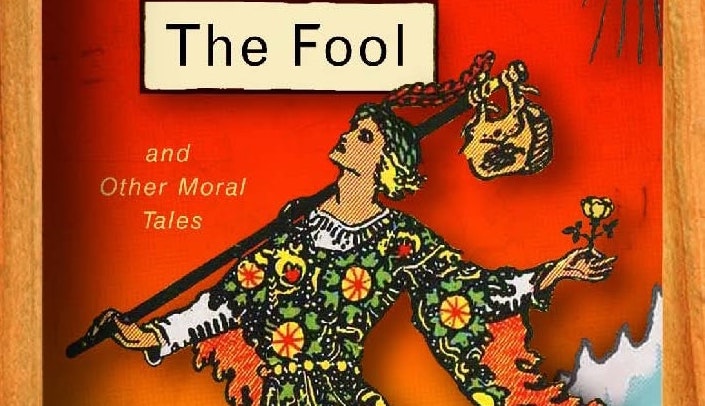
The Fool (and Other Moral Tales)
by Anne Serre
Translated by Mark Hutchinson
New Directions, 228pp., $13.97
Among the linty cling of rumors and backwashed gossip spread around the barrooms and laundromats of the universe, circulates this mortuary nugget: Hey, did you know that Ego, when it dies, would love nothing more than to attend its own funeral? Ego, in brazenly counterpointing Woody Allen’s proclamation — “I don’t mind dying, I just don’t want to be there when it happens” — would happily play the role of phantom witness while enjoying the privileged position of being able to float above its own death. It could view itself through the ceremony of mirrored eyes, and gauge its impact upon the audience gathered in its name. Ego, or the I-self, aspires to dream itself into a permanent narrative, to secure tenancy in a time-loop — it longs to know its movements are in accord with something lasting. This fretful existential dilemma, as it relates to writing, to functioning as a writer, and to the amorphic realm of stories and narrative, finds itself swaddled in the gallows’ silk of Love and Death, in Anne Serre’s new book, The Fool (and Other Moral Tales).


“The Narrator,” Serre’s second tale, revolves around a nameless narrator, who is dealing with the moral and existential ramifications of what it means to be The Narrator in a circumscribed world of his own making. This Fellini-esque tale skates coyly along the edges where reality begins and ends, or rather where reality and invention intersect. Confronted by characters who take on lives of their own, and question the methods and imperatives of The Narrator, solipsism, like THE FOOL, assumes many forms and guises. Serre chronicles The Narrator’s interior life, and its churning modalities, with impressionistic savvy, while wending her way through the forest of umbilical roots in which one’s original self gets lost: “How the little three-year-old narrator runs! It’s because he’s running behind his mother to prevent her dying from that he’s a narrator.” This Proustian search for lost time, or to live with razor-aired poignancy in pockets of crystallized time, drives The Narrator’s spiritual vagrancy, as he “wanders through landscapes as if he didn’t exist, as if he were the memory of himself . . . Were you to take a photo of a bus he was on, he might not appear in it. In his place, you’d see an empty seat.”
In Serre’s third and most provocative tale, “The Wishing Table,” the author conjures the blatant carnality of Marquis de Sade, in reflecting family dysfunction through a mirror darkly. A polymorphously perverse mother, cross-dressing father, and their three daughters, engage in unfettered sexual relations, in what reads as a Dionysian fairy tale with heartbreak seeded in its hidden center. The narrator, one of the daughters who has gone on to become a writer, coolly asserts, “… I wouldn’t want to appear to be justifying sexual relations with one’s family. I know only too well that it is a sensitive issue. But since I’ve decided to tell my life story, trying to set down as precisely as possible what I felt in that situation, which was obviously dysfunctional and yet functioned so well, no one is going to convince me to tear my hair out, to cover my head with ashes and weep. Because deep down, no one is weeping. On the contrary: everyone is laughing and calling out for a dance.” The narrator maneuvers, with haunted placidity and ingrown detachment, through her delicate minefield of a past, which includes erotic liaisons not only with her own family, but also with family friends. Recalling her mother’s genuine naivete regarding the severe impropriety of their relations, the narrator opines: “She thought that this what was life was like. And who’s to say she was wrong? The body we formed with our parents and their friends was so close-knit, the traffic between us so sublime and orderly, that the social worker’s words seemed to run up against a smooth, softly curved surface.” Yet, as the family’s psychically cannibalistic ecosystem begin to crumble, the narrator, as a teenager, strikes out on her own and undertakes an odyssey that moves her slowly toward the taproot of her “poor, broken heart” from which both her stories, and the need for telling those stories springs, and symbolized by “a marvelous shining disc of a table,” the totemic Rosebud encapsulating her childhood’s unrealized sorrow.
As a triptych, Serre’s collection speaks bravely, poignantly and perversely to the hazards of alienation — from one’s self, from those around you — while also illuminating the blessings and curses, the gifts and sacrifices, of being called to dwell in the gauzy world of stories.
@riotmaterial
[paypal_donation_button]
John Biscello is Book Critic at Riot Material Magazine. Originally from Brooklyn, writer, poet, playwright and performer, Mr. Biscello has called Taos NM home since 2001. He is the author of three novels, a short story collection, and poetry collection. He will be directing a short film he wrote, Ballad of the Cuckoos, with more info to be found here: Indiegogo/BalladoftheCuckoos