

by Allyn Aglaïa Aumand
On the coherence of fracture
an essay in fragments on fragments
*
I had a lover once, who self described as a volcano, but fully encased.
Make space to let it out sometimes, I told him.
That’s why I wanted to see you today, he said.
*

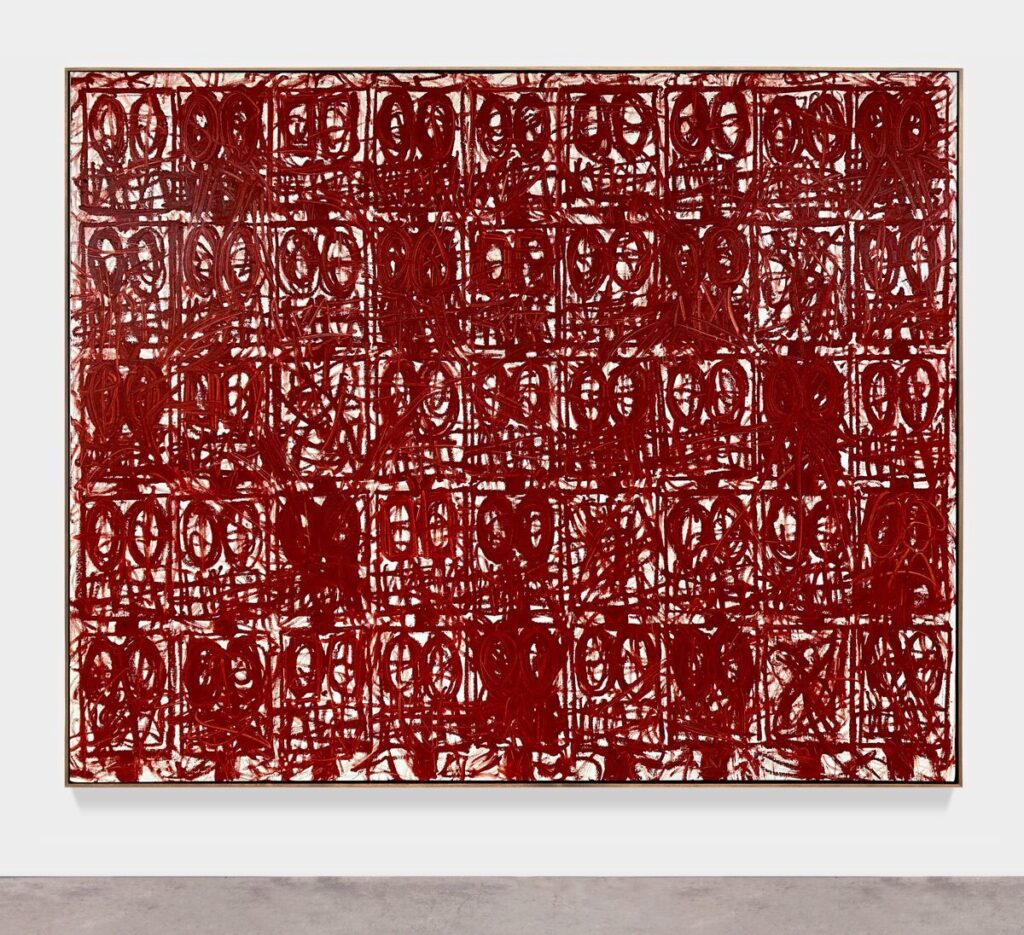
Hauser and Wirth
*
He bragged that his grief was bubbling just below the surface, safely contained. He had a neurotic impulse toward masking. Once I lay sprawled on the floor in front of him, bleeding, while he took a work call, laughing, joking, gossiping, sarcastic. I stared, horrified, and he covered the mouthpiece to assure me that he was lying. I’m hurting on the inside, he told me.
*
I stumbled upon Rashid Johnson’s exhibition, Waves, at Hauser & Wirth’s London gallery. It was Frieze week. The Covid version had no champagne, but Mayfair still had a muted buzz to it. Down the block, Victor Wang’s Institute of Melodic Healing had a fluid choreography: dancers stretching inside, visitors drifting in shifting constellations outside. The Goodman Gallery had a queue, along with a thermometer. Sirens sped down cloudy streets.
Inside, though, the world was suddenly quiet.
I stood directly in front of Johnson’s Anxious Red painting, close enough to feel its aura, and I wondered why this jagged, giant, mural of a work; an audience of anxieties; a grid of minds made chaotic in x’s and o’s, squiggles and swirls; some faces not even faces just aggressive brush stokes and no eyes.
Why did this chaos make me feel so calm?
It was, in the words of Karl Knausgaard, a “meteorology of the mind:” portraits of interiors, portraits of psyches. Portraits Johnson thought were self portraits, that every one saw as reflections of themselves, so in time, in his work, they multiplied. Anxious Men and Anxious Audiences.
*
Poetry is a form that has to break itself toward wholeness, Ocean Vuong said.
*


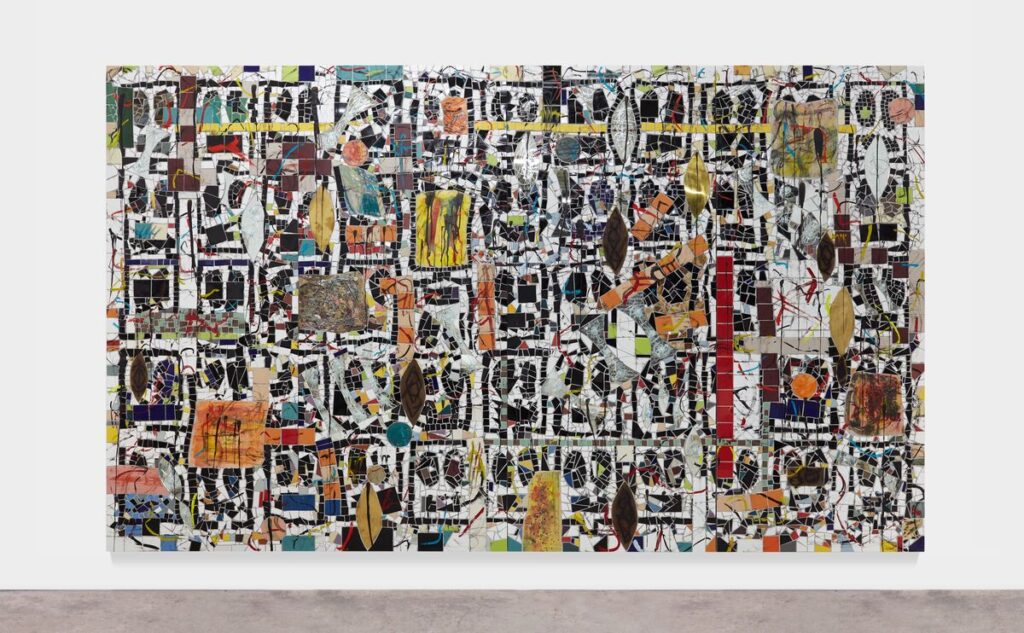
Hauser and Wirth
I watched a video of Johnson in his studio taking a mallet to a mirror embedded in one of his mosaics. The precision of his power was palpable. This incredible containment. This destructive action — a smashing — as part of creation.
I hadn’t thought of how the mirrors broke when I first admired them glinting in the gallery. They reminded me of shop windows with bullet holes and the web that emanates from the point of impact. My interior used to look like that. A disco ball dropped to the floor of the club, glinting splinters, ten million lives. Fragments of fragments. Glitter. I reach for the dust, trace it along the contours of my brow. Embedded, it glistens, and bleeds. A self portrait. All of it.
*
Lao Tzu wrote: be broken to be whole.
This makes me think of the canon.
*
My lover glinted in the flashing neon lights the night I met him. It took me years to realize he was a prism. Cold, hard, glass, edges, around an empty center. A thousand personas, ten thousand lies.
*
Of course
The Lover’s Discourse
Was written
In
Fragments
I scrawled, on loose leaf paper that drifts around my apartment.
Barthes wrote on dark glasses; agony; clouds.
I am engulfed, I succumb…
*

Hauser and Wirth
*
Jack Whitten writes on his painting as collage. He writes on all that is contained in the fractures that he pastes, one by one, at angles, glinting, into his massive collage-paintings. He calls the pieces, the bits, the bytes, tesserae, each one a chunk of acrylic that has been cut from a large slab.
My interest of course is always about how I can use it to direct the light, he said.
*
Whitten’s collected studio writings are recently published in Notes from the Woodshed, a beautiful tome collected, ordered, edited, by Katy Siegel and published by Hauser & Wirth.
For decades, Whitten wrote with pencil on paper, on receipts, in notebooks and other slips in his studio.
I AM THE OCEAN (11 May ’94)
SPACE IS ONLY A FEELING. (3 April ’94)
I AM A TIME TRAVELER (24 May ’94)
*Mike, I must change the title of your painting for the second time, sorry about that but it’s important. I’m sure you will understand. (March 28-April 3, 2009)
Must accept philosophical notion of death in life. Everything happens in Life. (March 2, 2006)
Tell them that we bathe ourselves in Light. (STUDIO LOG ’08 29 Jan)
Dimensional light is a means of structuring the gap between painting and sculpture. The Multi-Dimensional worldview in which the NOW is located. (September 8, 2008)
Before the book, his studio notes lived in drawers.
To be in the woodshed is to be deeply inside, it is to make space for all that happens in the artistic process that is protected, unseen, not ready for public consumption.
Whitten never meant to publish his notes, though he gave Siegel his blessing, and contributed essays for the less documented decades before he died.
At the (Zoom) book launch, Legacy Russell noted briefly how, in the pandemic period, we are all woodshedding.
*
Whitten’s piece at MoMA, Atopolis, is a massive collage-as-painting for Édouard Glissant, the poet-philosopher and author of the concept archipelagic thought (and many other concepts for our time.)
When I think of Glissant I think of island thought, and then I think of Kamau Brathwaite and island rhythms and tidalectics. Archipelagic thought is to think of ourselves as plural, as a series of islands, a series of discrete, separate multiplicities, each beautiful, and distinct, a coalescence of creolity, multiple beings within each island, and, each island spread across the sea, constellations that build on each other, the embodiment of individuality en masse, and our connectivity, and this fluidity as extant in contrast to continental thought, that is the one with harsh borders, solidity, certainty. Island thought is in the flux of the waves. I decided I could not be by the sea during my own woodshedding, I needed not to be pulled with the tides, but rather to gather my fragments and see what remains. Archipelagic thought, which has become synonymous with future thought, ((The Multi-Dimensional worldview in which the NOW is located, Whitten wrote)) when considering the deconstructions of the canon and its reorganization, well, anyway, it’s not unlike collage.
*

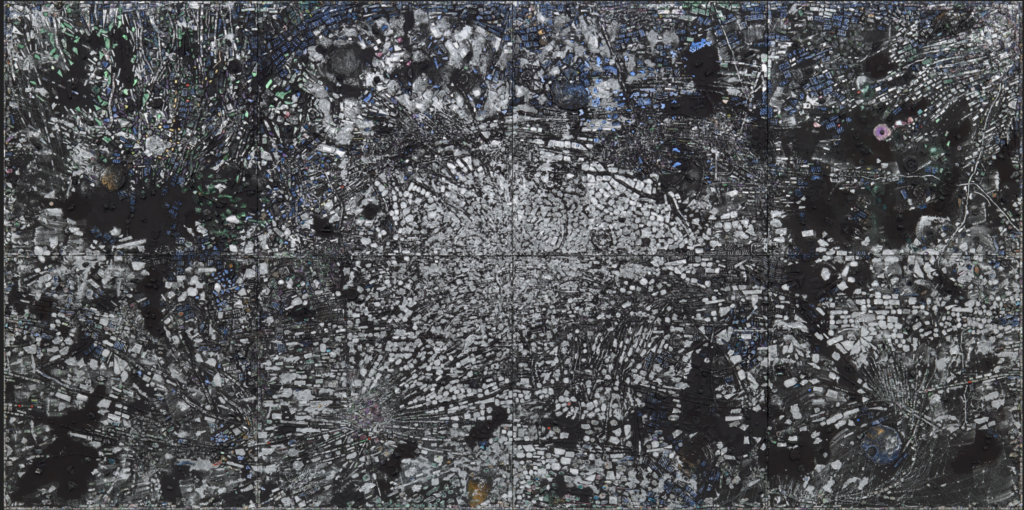
MoMA
Is fracture about breakage, then, or is fracture about wholeness? And this is precisely my point. The breaking is the wholeness. The jagged multiplicity, lovingly stitched together, or, aggressively pounded with the mallet, this is the whole. A being as a series of islands and also all the mixage embodied on the islands. Consent not to be a single being, Glissant wrote. The truth of this paradoxical “first-person plural,” Jean-Luc Nancy wrote, “We” says (and “we say”) the unique event whose uniqueness and unity consist in multiplicity.
Collage, and perhaps the canon as : the collection of light. Selecting, learning to direct the light. Can we center in refraction and tell our narratives from there?
*
Kinetic art making is important because motion happens to and with and in the creation of the fractures. And in motion we change. Thus the fluidity as futurity in Glissant, who wrote A Treatise on the Whole-World. Johnson spoke of the physicality of his process and of how the making of these works was a direct engagement with his anxiety.
This violent making, this catharsis, this breaking creating; it set me free, he said.
*
Poetry is a form that has to break itself toward wholeness, Voung said.
Break
toward
wholeness.
((And Fred Moten wrote In the Break.))
*
The burning light projects limitlessly, Glissant wrote.
And,
The Chaos-World, Unpredictable, Multiplies Rhetorics.
And
Archipelagic thinking suits the pace of our worlds. It has their ambiguity, their fragility, their drifting…It means being in harmony with the world as it is diffracted in archipelagos.
And
The thinking of the archipelago, the archipelagos, opens these seas up to us.
And
Interrelations proceed largely through fractures and ruptures. They are even perhaps of a fractal nature: this is why our world is a chaos-world.
Which brings us back to the peaceful chaos of Johnson’s works in the peaceful chaos of our fractured world.
Break toward wholeness.
*
Johnson spoke of his mosaics as an offshoot of the Anxious Men series, and the Anxious Audience series, both of which predate the series included in Waves.
The mosaics, he said, have more permanence.
What with the cement. The solidity of the materials. Heavy, dense, along the walls
((The exhibition was called Waves.//I AM THE OCEAN, Whitten wrote.))
There is something simultaneous in the solidity of Johnson’s fracture, a question about process, a question about healing. A question of arrival. And the truth of the presence of our fracture, as an end in itself, or at least as a state in itself. Here we are. In motion, or, in concrete, or in concrete holding palpable motion, but real, broken, and fluid, whole, and alive. Profoundly interconnected and profoundly fractured.
To enter this, to make in this, to let it out, to let it be, to unmask and to embody the fracture, Johnson said:
It set me free.
♠
Featured Image: Rashid Johnson, The Broken Five (2020). Hauser and Wirth
Allyn Aglaïa Aumand is a writer, scholar, artist, and curator. Publications include The New Yorker, The Atlantic, The New York Times, Guernica, The Los Angeles Review of Books, The Berlin Quarterly, Very Vary Veri of the Harvard School of Design, and many others.